Years analyzing LSAT courses, pricing, tools, and student outcomes.
Helping students compare courses and choose the right study plan.
Confident LSAT prep recommendations for your law school path.

Are you trying to get into a great law school? There’s something you have to know:
Getting into one of the 10 best law schools in the country requires an LSAT score of at least 170; the bare minimum for acceptance into a decent law school is 150.1
Our pick for the Best LSAT Prep Course is Blueprint’s 170+ Course.
Go to Blueprint now or see the full list below.
Read More
You probably already know that this is much easier said than done. But there is a way to make it easier for you to achieve a high LSAT score:
Choosing the best LSAT prep course is a very important decision that plays a huge role in scoring high on the LSAT and getting into the law school of your dreams. That’s why it’s important to choose the best LSAT review course possible.
If you’re doing it right, you will be spending a lot of time studying for the Law School Admission Test. The University of Massachusetts Amherst recommends at least 100 study hours over a four-month period— but you’ll probably want to study even more than that.2 After all, your LSAT score is the best way to make the strongest impression on your law school applications when trying to get into the top law schools.
And with so much at stake, it’s crucial that you find the LSAT study materials that best fit your learning style and background. So here’s the good news:
I have personally researched and reviewed every major LSAT course online to make things easier for you! The comparison chart below will help you decide which set of prep materials are the best fit for your needs.
Quick LSAT Course Comparison
| Course | Pricing | Study Style | Start Here |
|---|---|---|---|
| Blueprint LSAT | $$$$ | Live classes, self-paced lessons, analytics, and practice exams | View Blueprint |
| Kaplan LSAT | $$$$ | Live instruction, LSAT Channel lessons, instructor help, and practice questions | View Kaplan |
| Magoosh LSAT | $$ | Affordable self-paced lessons and practice materials | View Magoosh |
| 7Sage LSAT | $$$ | Organized lessons that are easy to complete in shorter sessions | View 7Sage |
| LSATMax | $$$$ | Tutoring access, Solomon AI feedback, and missed-question review | View LSATMax |
Recommendation Finder
Not sure which LSAT prep course is right for you? Expand the categories below to quickly find the best fit based on your budget, learning style, and study goals.
Best Overall
Blueprint is our top overall LSAT prep course thanks to its combination of engaging lessons, strong analytics, live class options, and excellent student experience. It’s a strong, live class options, and excellent student experience. It’s fit for most students looking for a balanced and comprehensive prep solution.
Best Live Classes
Kaplan stands out for students who prefer live instruction and classroom-style learning. Their live courses provide accountability and a more guided study experience.
Best Budget Option
Magoosh is one of the most affordable LSAT prep courses while still offering strong lesson quality and practice materials. It’s ideal for students who want solid prep without spending thousands of dollars.
Best for Busy Students
7Sage works especially well for students balancing work or school because the platform is flexible, organized, and easy to study in shorter sessions.
Best Tutoring and AI Feedback
LSATMax is a strong choice for students who want tutoring access and Solomon AI feedback for missed-question review. It’s a good fit if you want more help understanding where your reasoning went wrong.

Which LSAT Course is Right for You?
We’ve put together a short list of questions that will help us determine which LSAT course is the best pick for you!
1. Blueprint: Best for All-in-One LSAT Prep

OVERALL RATING:
Blueprint LSAT
Study Plan, Live, Exams, Qbank, Journal, Analytics, Resources, and Community sat in one top menu, so I was not hunting for tools.
Daily practice and official-style sets felt close enough to the real LSAT that I stayed in the Qbank instead of bouncing out.
Moving between practice and analytics made it obvious what still needed work after a study block.
Office hours and live review on select plans kept the course from feeling like a solo video library.
Blueprint fits students who want a full LSAT command center: lessons, practice, exams, and planning in one place. It is less ideal if you only need quick drills.
| Practice questions | 7,000+ real LSAT items |
|---|---|
| Exams | 59 LawHub exams; 16 full-length with analytics |
| Planner | Personalized LSAT study planner |
| Community | Interactive chat and learner community |
For me, Blueprint was the most complete all-in-one setup. The dashboard kept every major tool visible, even if the feature set can feel heavy when you only want short practice sessions.
Blueprint had the most polished student dashboard. The top menu was easy to follow, with separate tabs for Study Plan, Live, Exams, Qbank, Journal, Analytics, Resources, and Community. I liked that because I did not have to guess where the main tools were hiding.
How Blueprint’s dashboard kept every study tool in reach
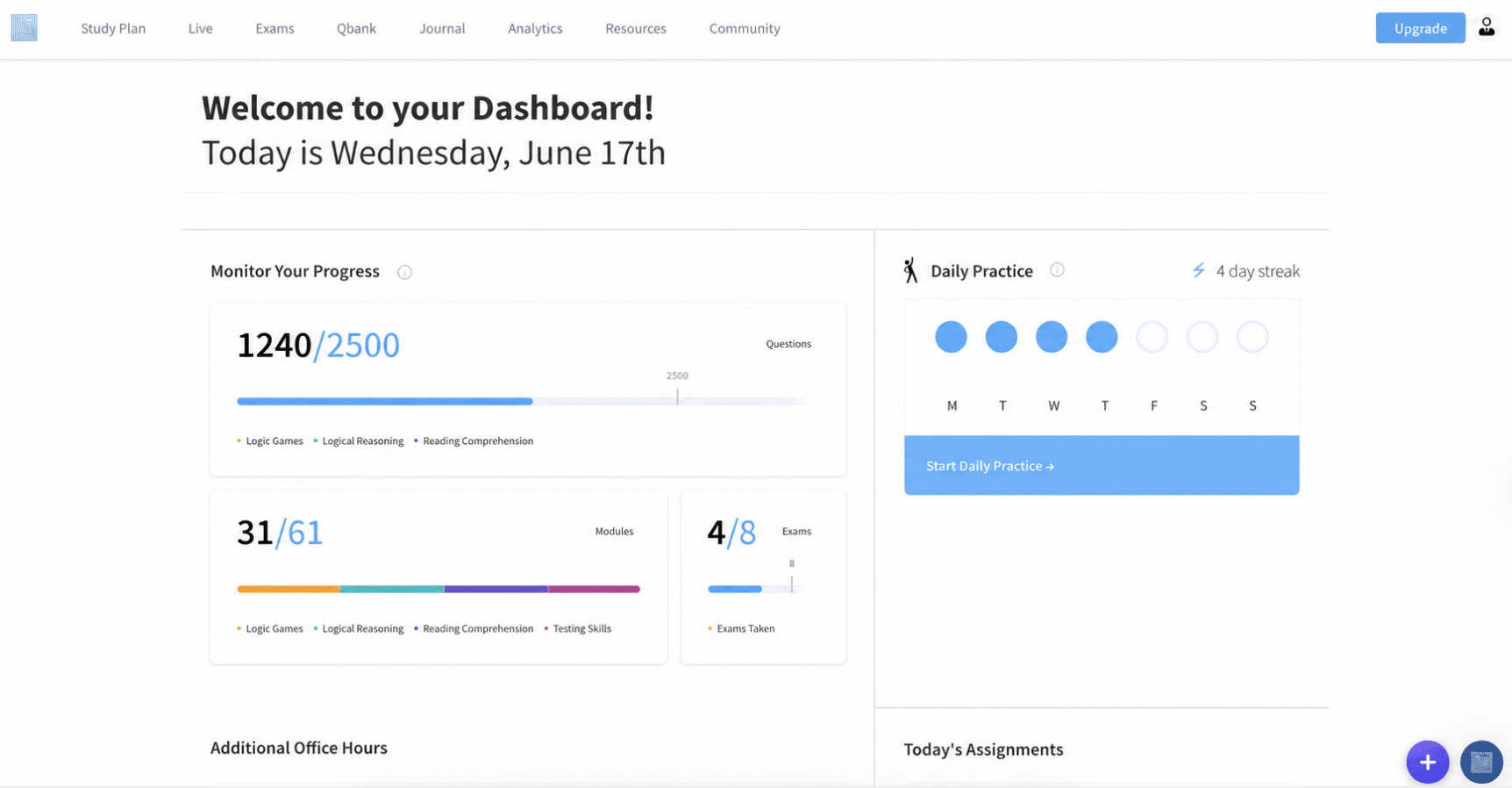
The dashboard also made the course feel more active. I could jump into daily practice, check assignments, look at office hours, and move between practice questions and analytics without feeling like I was piecing the course together myself.
The only thing I would watch is that Blueprint can feel like a lot if you just want quick drills. It is built more like a full LSAT command center, which is great if you want structure, but maybe too much if you only need extra practice.
Best Parts
- Interactive learning modules and video lessons
- Personalized LSAT study planner
- 7,000+ real LSAT practice questions
- 59 official LawHub exams
- 16 full-length exams with analytics and explanations
- Performance analytics
- Live review options on select plans
- Interactive chat and learner community
Blueprint LSAT

Get $400 Off Blueprint LSAT 170+ Course
Pros
✅ Planner was easy to move around.
✅ Videos felt way less boring than expected.
✅ Practice felt close to the real thing.
✅ Instructors clearly know the test.
Cons
❌ A lot if you only want quick drills.
❌ Too much screen time for me after a while.
❌ Higher plans are a big commitment.
2. Kaplan: Best for Live Class Support

OVERALL RATING:
Kaplan LSAT
Live Online felt like a real class. Side chat handled small questions while the instructor kept working through Logical Reasoning.
On-demand LSAT Channel lessons helped when one explanation was not enough.
Nearly 6,000 official LSAC questions plus interactive hints while answering.
The Personalized Study Calendar helped sequence work, even though the dashboard itself felt busy at first.
Kaplan is strongest if live class energy and instructor access keep you accountable. On-Demand still includes instructor access, but you get less of the live-chat benefit.
| Formats | On-Demand and Live Online |
|---|---|
| LSAT Channel | About 60 hours of lessons |
| Questions | Nearly 6,000 official LSAC items |
| Extras | Tutoring and 170+ plans available |
Kaplan won me over in live class, not on dashboard polish. If you will actually show up for Live Online, the chat-and-instructor setup is the reason to pick it.
Kaplan’s chat was honestly the part that sold Kaplan’s Live Online class for me. The instructor was working through a Logical Reasoning question, and people kept dropping smaller questions off to the side. Someone from the support team answered them while the lesson kept moving, so the whole class did not get stuck every two minutes.
What Kaplan’s LSAT Channel looked like after Live Online
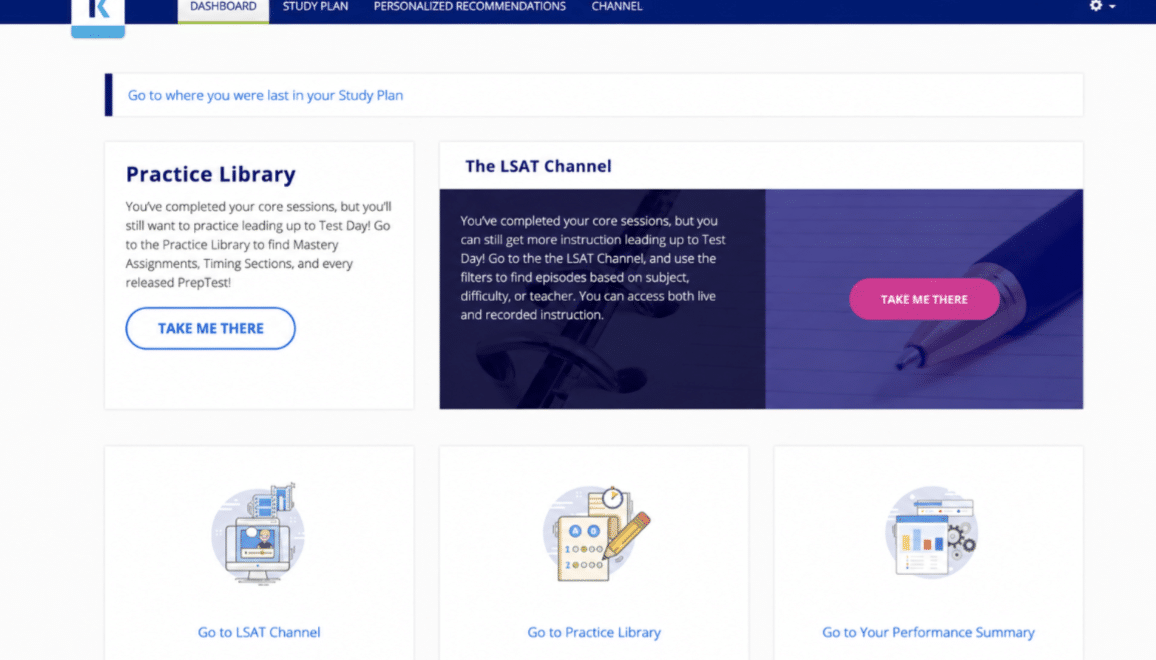
Kaplan has a lot going on once you start clicking around. The LSAT Channel, practice sets, and Personalized Study Calendar took some sorting out. The dashboard is not especially cute or modern, but the actual class setup works. It feels like a real place to show up, ask questions, and get through the material without piecing everything together alone.
Course Perks
- On-Demand and Live Online course options
- 60 hours of LSAT Channel lessons
- Nearly 6,000 official LSAC questions
- Personalized Study Calendar
- Interactive hints while answering questions
- Instructor team access
- 170+ courses with live instruction and score guarantee
- Private tutoring options
Kaplan LSAT

Save Up to $170 Off Kaplan LSAT Live Online Course
Pros
✅ Live class did not feel like a sleepy webinar.
✅ Chat helped with smaller “wait, what?” moments.
✅ LSAT Channel helped when one explanation was not enough.
✅ On-Demand still includes instructor access.
Cons
❌ Dashboard felt kind of busy to me at first.
❌ Live classes only help if you actually show up.
❌ Tutoring and 170+ plans can get expensive fast.
3. Magoosh: Best Budget Option

OVERALL RATING:
Magoosh LSAT
Missed Logical Reasoning items got trap-answer breakdowns, not just the correct letter.
Timed sets used an interface close to the real LSAT setup.
6,000+ official LSAT questions with 1,000+ written explanations.
One- to six-month schedules were easy to scan without a complicated planner UI.
Magoosh fits budget-minded students who learn well from video explanations and can self-manage. It is weaker if you need instant, real-time tutoring.
| Questions | 6,000+ official LSAT questions |
|---|---|
| Videos | 80+ strategy lessons |
| Support | Email tutor help; Guided Study add-on |
| Trial | 7-day free trial with lessons and questions |
Magoosh is the budget pick I would take for clear explanations and realistic timed practice. Support stays email-first unless you add Guided Study.
Where Magoosh explanations taught the trap answer
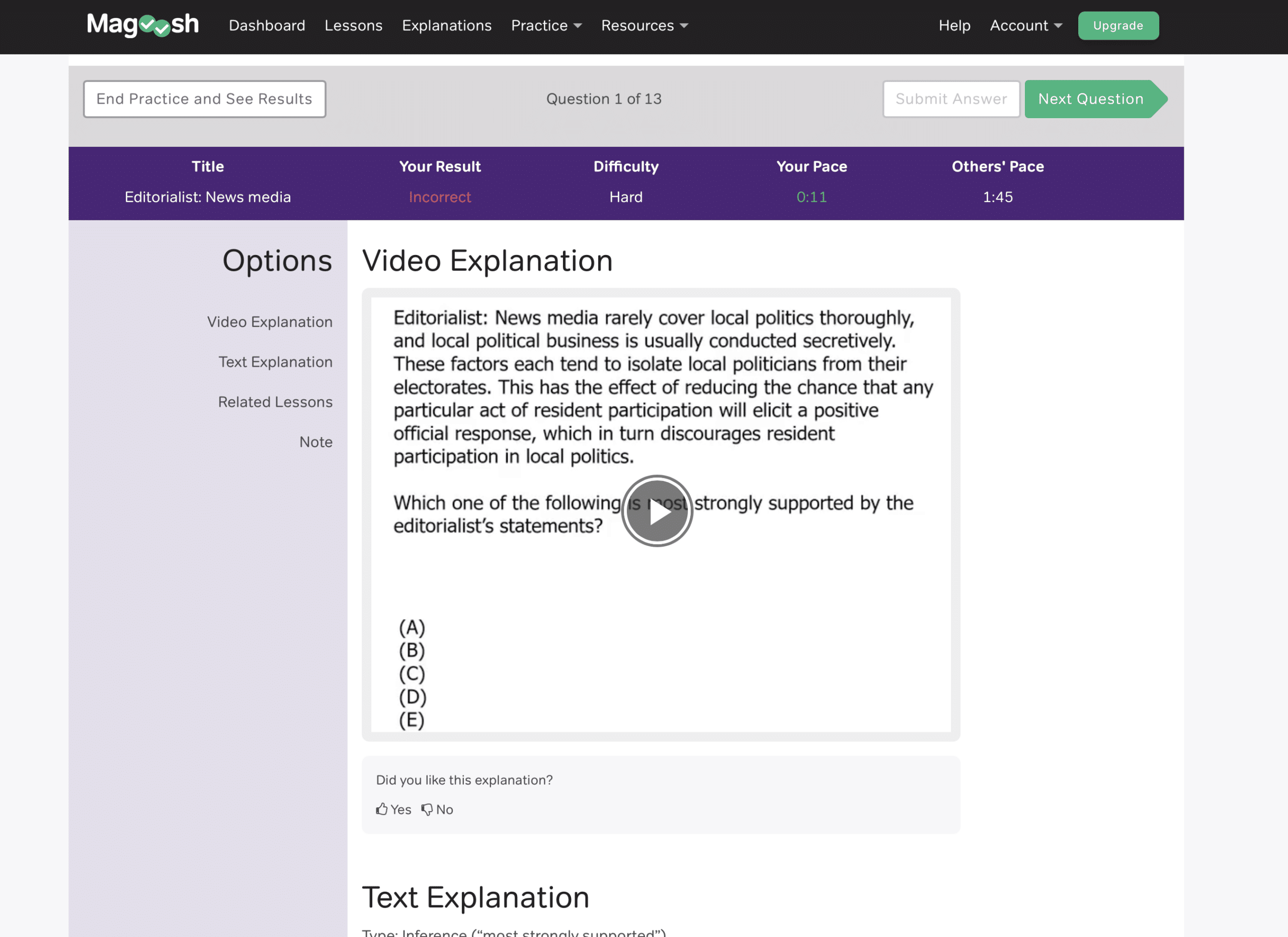
Magoosh felt smaller than Blueprint and Kaplan, but that was not a bad thing. I went into the Premium plan, did a few practice questions, and the review side was what stood out.
When I missed a Logical Reasoning question, the explanation did not just toss me the correct answer and move on. It broke down why the trap answer was tempting, which is the part I actually need help with. I also tried the timed practice, and the screen looked close to the real LSAT setup.
The weaker spot is support. Email help is there, and Guided Study adds on-demand classes, but Magoosh is still better for independent review than real-time help.
Standout Tools
- 6,000+ official LSAT questions
- 80+ video strategy lessons
- 1,000+ question explanations
- Timed practice tests on the official LSAT interface
- One- to six-month study schedules
- Email assistance from tutors
- +5 total score guarantee
- Guided Study add-on with 12 hours of on-demand classes
- 7-day free trial with 20 lessons and 40 official questions
Magoosh LSAT

Pros
✅ Strong explanations for missed questions.
✅ Good price for the official practice included.
✅ Study schedules were easy to scan.
✅ Guided Study adds more help without a full live course.
Cons
❌ Tutor help is through email, so it is not instant.
❌ The dashboard is simple, not polished.
❌ It puts more responsibility on you to keep going.
4. 7Sage: Best for Heavy Drilling

OVERALL RATING:
7Sage LSAT
Foundations, Logical Reasoning, Reading Comp, Practice, and Pre-exam sat on a dated timeline.
Student posts and community updates made the course feel less empty between drills.
LR in Action, Office Hours, and Advanced Conditional Reasoning were easy to spot from the dashboard.
Adaptive drill access kept practice organized, even when the UI looked plain.
7Sage fits drill-first students who want a clear plan and community discussion more than a polished visual interface.
| Plan | Dated study-plan timeline |
|---|---|
| Live | Sessions and office hours on the dashboard |
| Community | Discussion board and bookmarks |
| Extras | Law school cycle tracker |
7Sage is reliable and organized, not flashy. The plan and discussion board carried it for me more than the look of the dashboard.
How 7Sage’s study-plan timeline ran my testing week
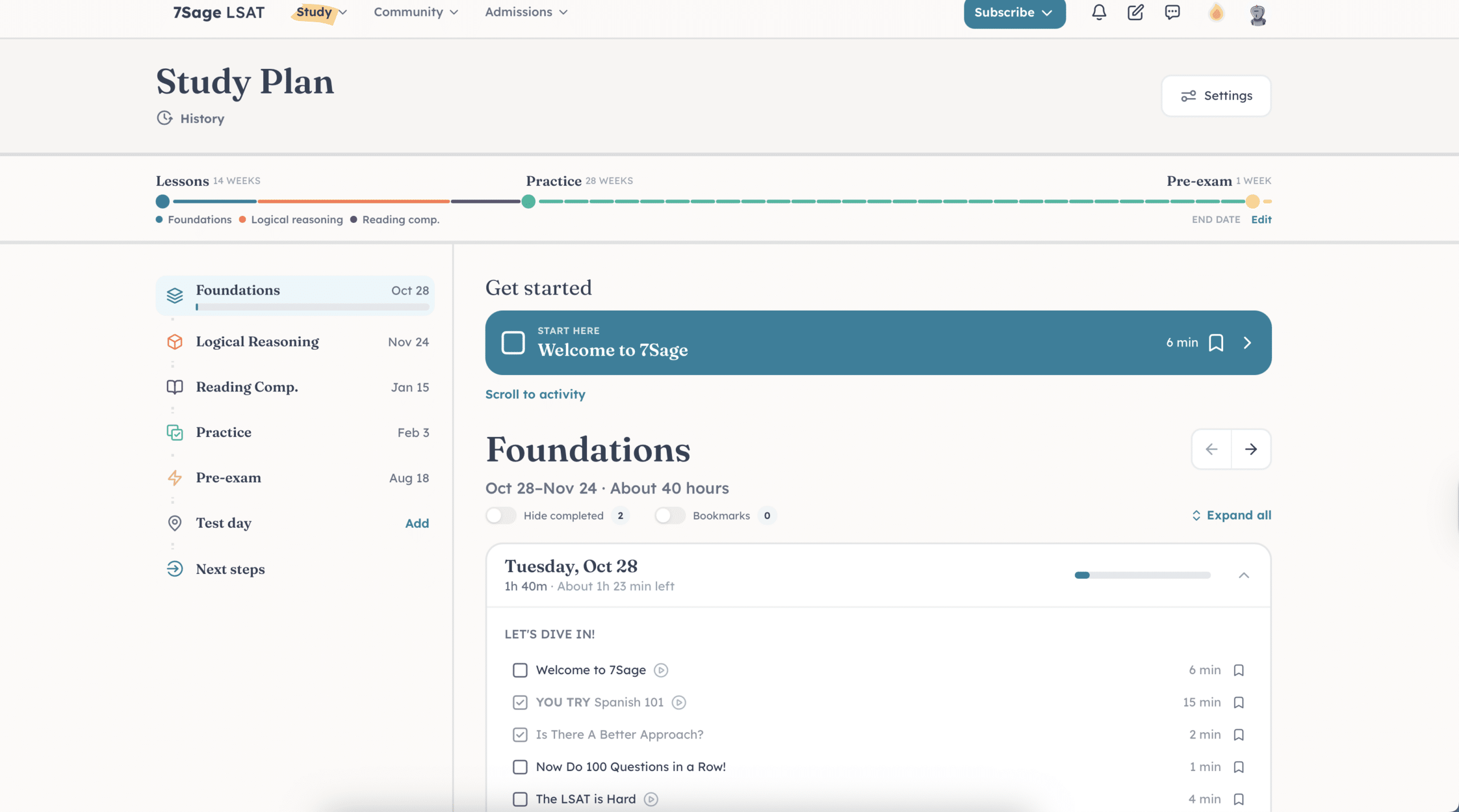
7Sage was easy to start with, but it was also kind of plain. My dashboard had the study plan at the top, discussion posts on one side, and live sessions on the other. I could see sessions like LR in Action, Office Hours, and Advanced Conditional Reasoning, which made the live side look more active than the dashboard itself.
The study plan was very clear. Mine was split into Foundations, Logical Reasoning, Reading Comp, Practice, and Pre-exam, with dates beside each section. I liked that because I could tell what I was supposed to do next without guessing.
The discussion area was the coolest part. I could see posts from other students, community updates, and places to talk through LSAT stuff. The practice was reliable, but not exciting. It worked. It just did not make me want to keep clicking around.
What I Had on the Dashboard
- Study plan timeline
- Foundations, Logical Reasoning, Reading Comp, Practice, and Pre-exam sections
- Adaptive drill button
- Discussion board
- Live sessions and office hours
- Bookmarks
- Community area
- Law school cycle tracker
- Add LSAT and test day sections
Pros
✅ The study plan was very easy to follow.
✅ Discussion groups made the course feel less empty.
✅ Live sessions were easy to spot from the dashboard.
✅ Practice felt reliable and organized.
Cons
❌ Dashboard looked plain compared with other courses.
❌ Practice was useful, but not very motivating.
❌ The course may feel boring if you need a more visual setup.
5. LSATMax: Best AI Feedback and Tutoring Access
OVERALL RATING:
LSATMax
After a missed Logical Reasoning question, Solomon explained the trap and where my reasoning went off.
99th-percentile tutoring is still the core product; AI fills the gaps between sessions.
90+ official PrepTests plus missed-question post-mortems.
24/7 access and a free half-hour assessment before buying tutoring hours.
LSATMax fits students who want tutoring plus AI feedback more than a full live-class platform. Visual learners who need lots of video teaching may want a thicker course.
| AI | Solomon AI for question help |
|---|---|
| Tutors | Private tutoring options |
| PrepTests | 90+ official PrepTests |
| Focus | Logical Reasoning and Reading Comp support |
I treated LSATMax as tutoring support with strong AI follow-up, not as a complete Blueprint-style course. That niche use case is where it earns a spot.
The AI tutoring add-on caught my attention first. LSATMax feels different because Solomon AI is such a big part of the setup, but tutoring is still the main thing behind it.
Testing Solomon AI after a missed Logical Reasoning question
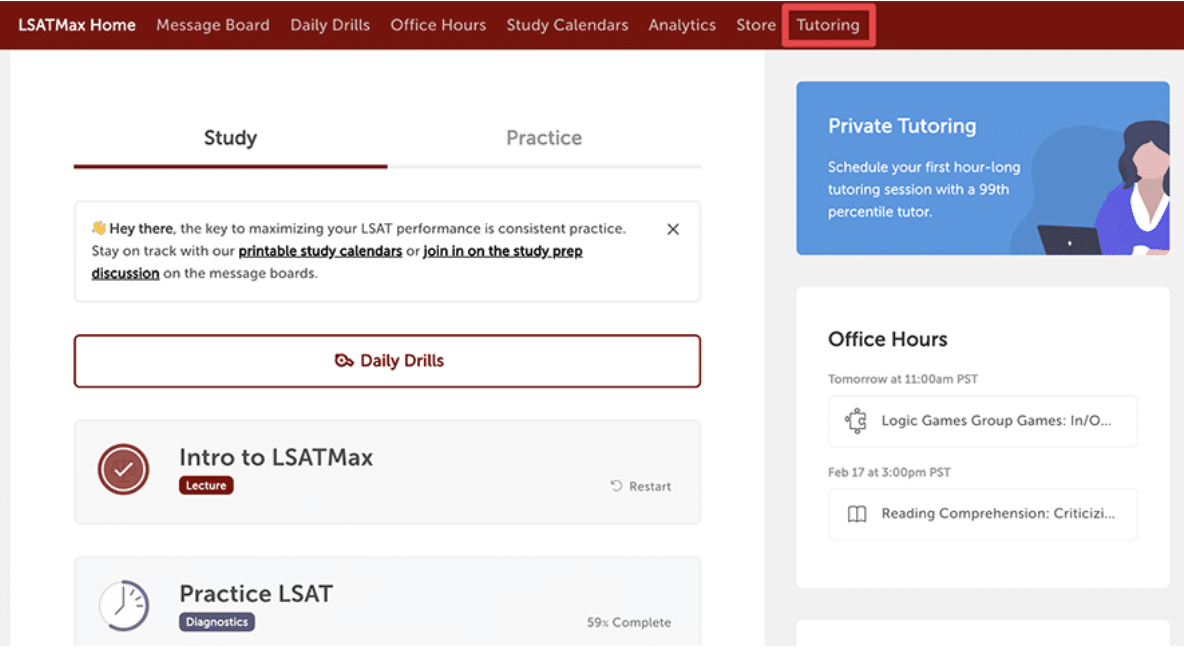
I used Solomon after a missed Logical Reasoning question. It broke down why the wrong answer looked normal, what trap I fell for, and where the reasoning went off. That was more helpful than a basic answer key.
The course does feel thinner than something like Blueprint. It does not have the same full lesson-and-practice setup, and visual learners may want more video teaching. But if you want lighter prep with tutoring access and AI help between sessions, it still has a clear use.
Course Tools
- Solomon AI tutor for question help
- Missed-question post-mortems
- Logical Reasoning feedback
- Study plan tweaks based on weak areas
- 24/7 access
- 90+ official PrepTests
- Private tutoring options
- Reading Comprehension support
LSATMax Review
Pros
✅ 99th-percentile tutors are the strongest part.
✅ Solomon explained the mistake behind the missed question.
✅ The free half-hour assessment helps before paying for hours.
✅ AI feedback gives you something to use between sessions.
Cons
❌ No full live-class course like Kaplan or Princeton Review.
❌ Not enough video lessons for visual learners who want full teaching content.
❌ Feels more like tutoring support than a complete study platform.
How I Ranked These LSAT Prep Courses
I ranked these courses by what stood out once I got inside each platform. I looked at how easy the dashboard was to use, how helpful the explanations were after missed questions, whether the practice felt close to the real LSAT, and what kind of support each course gave. I also paid attention to what got annoying, because that matters too. A course can have a huge feature list and still be a pain to use.
Final Takeaway
Not every LSAT prep course fits every student, which is why the best choice depends on how you study. Blueprint had the most complete setup for me, with lessons, practice, exams, and planning all in one place. Kaplan was better for live class support. Magoosh worked for affordable explanations. 7Sage kept practice simple. LSATMax was more niche, but useful for tutoring and AI feedback. Pick the course that fixes your biggest study problem first.
FAQs
The best LSAT prep course depends on what you need most. Blueprint is a strong choice if you want a full course setup with lessons, practice, exams, and analytics in one place. Kaplan is better if live classes help you stay focused. Magoosh is a good fit if you want affordable video explanations and official practice.
Most students should give themselves at least a few months to study for the LSAT, especially if they are starting from scratch. A shorter timeline can work if you already have a strong baseline score, but rushing usually makes review messier. I would rather have a clear study plan than try to cram random questions at the last minute.
No. Logic games were removed from the LSAT starting with the August 2024 test. The current test has scored Logical Reasoning and Reading Comprehension sections, plus one unscored section. That is why it matters to choose a course that has updated its lessons and practice for the newer LSAT format.
A lot of paid LSAT prep courses either include LawHub access or require you to pay for it separately. LawHub matters because it gives you access to official LSAT PrepTests and the real test-style interface. Before buying a course, check whether LawHub is included or listed as a separate fee.
Yes, LSAT prep can improve your score, but only if you review the right way. Doing questions is not enough by itself. The biggest improvement usually comes from figuring out why you missed a question, spotting repeated mistakes, and practicing under timed conditions. That is why explanations, analytics, and realistic practice tests matter.

Bryce Welker is an unstoppable force in the worlds of business and education. He’s a dynamic speaker, expert blogger, and a regular contributor to top-tier publications like Forbes, Inc.com, Business.com, and AccountingToday.com. With a proven track record of founding over 20 innovative test prep websites, Bryce has helped countless students and professionals pass their certification exams and achieve their dreams. Whether you’re seeking career advancement or educational success, Bryce Welker is the ultimate guide to help you get there.

