
Are you tired of sifting through countless LSAT prep course reviews, unsure which one will give you the edge you need?
You’re not alone.
Every year, thousands of law school hopefuls face the same dilemma: which LSAT prep course will catapult them to their dream score?
But here’s a statistic that might surprise you.
According to the Law School Admission Council, only about 30% of test-takers achieve their desired score on their first attempt. So, what separates this successful minority from the rest? The answer might lie in the prep course they choose.
Dive in as we dissect the top contenders in the LSAT prep world and discover which one could be your ticket to LSAT success.
LSAT Prep Courses At a Glance
| Course | Best For | Main Strength | Main Drawback |
| Blueprint | Best overall LSAT prep | Clean study flow, interactive lessons, study plan, analytics | Starter has less live support |
| Kaplan | Traditional LSAT prep | Class-style structure, instructor help, LSAT Channel | Not the most modern platform |
| Magoosh | Simple self-paced prep | Easy layout, video explanations, mobile study | Less accountability |
| Princeton Review | Live LSAT classes | Strong live course options and PrepTest access | Can feel bulky |
| 7Sage | No-frills drilling | Smart Drills, official explanations, simple self-study | Plain and outdated interface |
| LSATMax | Practice volume | Large question bank, official PrepTests, mobile access | Less polished study experience |
1. Blueprint LSAT Prep: Best Overall for Interactive Study and Analytics
Blueprint was my top LSAT pick because it had the smoothest path from learning to practice to review. When I moved through the self-paced course, I did not feel like I was jumping between random tools. The lessons, study plan, Qbank, LawHub exams, and analytics all felt connected.
That was the main thing I noticed during testing. Blueprint does not just give students LSAT material. It helps organize what to do with it.
Blueprint’s Interactive Lesson Modules
I started with Blueprint’s module path because that is where the self-paced course is built. The 61 interactive modules were easier to follow than a plain video library. I could tell what topic I was in, what skill the lesson was trying to build, and where the course expected me to go next.
The lessons also felt more active than just watching a long recording. That helped Blueprint feel more like a real course instead of a content folder. For LSAT prep, that kind of structure matters because it keeps students from bouncing between question types with no plan.
Blueprint’s LSAT Study Plan
The study plan was the part that made Blueprint feel the most organized. I checked how it lined up lessons, drills, exams, and review, and it gave the course a clear rhythm.
I liked that it did not treat studying as only “watch this” or “take this test.” The plan mixed different parts of prep together, which is what students need for the LSAT. It also made the course feel less overwhelming because the next step was easier to find.
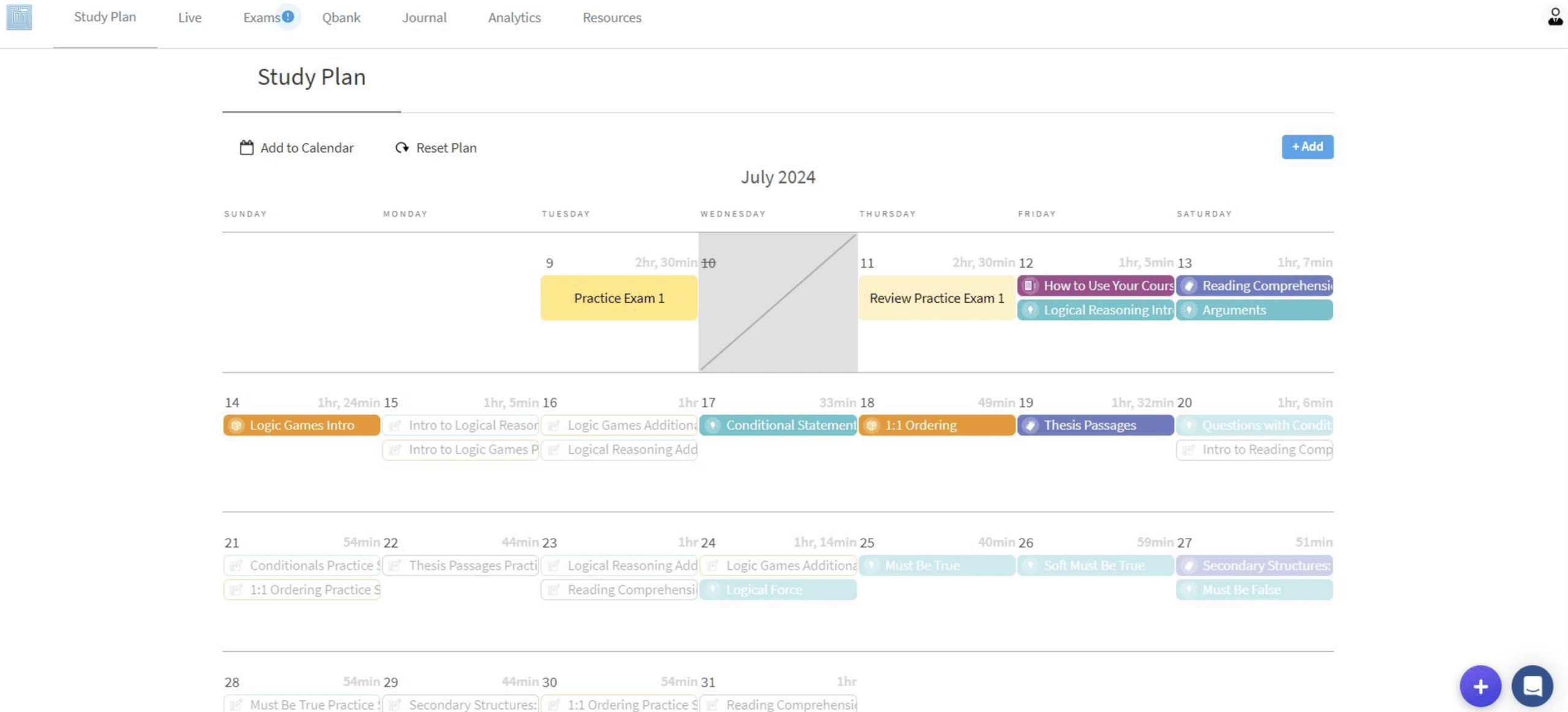
This is where Blueprint had an advantage over courses that give students a lot of material but leave the planning up to them.
Blueprint’s Practice Review and Analytics
The practice review was the strongest part of Blueprint for me. I looked at the Qbank, official LawHub exam access, full-length tests, explanations, and analytics. Blueprint includes 7,000+ real LSAT questions, all 59 official LawHub exams, and 16 full-length exams.
The review tools made practice feel more useful after I finished a question set. Instead of only checking right and wrong answers, I could see how the results could point students back to what they need to work on.
That is why I ranked Blueprint first. The course made the review step feel built in, not like something students have to figure out alone.
Blueprint LSAT Course Packages
| Package | What’s Included | Best For |
| Starter | Interactive modules, LSAT Study Plan, Qbank, official LawHub exams, analytics, and explanations | Students who want Blueprint’s self-paced course |
| Pro | Everything in Starter, plus unlimited live review sessions six times per week, interactive chat, online community, and score-increase guarantee | Students who want self-paced prep with live help |
| Pro – Prep Longer & Save | Starter access, live review sessions, score-increase guarantee, and longer access options | Students who want more time before test day |
| Live Course | 30 hours of live instruction, full Self-Paced Course access, and score guarantee | Students who want scheduled live classes |
| 170+ Course | 60 hours of live instruction, personalized coaching, and 170+ score guarantee | Students aiming for a top LSAT score |
| LSAT Tutoring | One-on-one tutoring, personalized study plan, and score-increase guarantee | Students who want private LSAT help |
Blueprint LSAT Course Ratings
| Aspect | Rating |
| Lessons | 9.6 / 10 |
| Practice Questions | 9.5 / 10 |
| Explanations | 9.6 / 10 |
| Study Plan | 9.6 / 10 |
| Live Support | 9.3 / 10 |
| Ease of Use | 9.5 / 10 |
| Overall Average | 9.52 / 10 |
Pros
✅ Lessons felt more active than a plain video library
✅ The study plan made the course easier to move through
✅ Practice connected my results back to what to study next
✅ Live review options add help without making the course fully live
Cons
❌ Starter is lighter than Pro if students want live support
❌ A data-heavy review may be more than casual students need
Why Blueprint Works
Blueprint ranked first because it made LSAT prep feel the least scattered. I could move from lesson work to official practice to review without losing the thread, which made it the strongest overall course I checked.
2. Kaplan LSAT Prep: Best Traditional LSAT Prep Course
Kaplan is the LSAT course I’d use for a student who wants a clear class-style prep setup instead of a newer, dashboard-heavy platform. When I reviewed it, the layout was easy to size up. I could see the lesson path, practice tools, LSAT Channel, study calendar, and live class options without digging around too much.
It did not have the same modern testing feel as Blueprint, but it was easier to understand right away. Kaplan’s strength is that it gives students a normal prep-course experience: lessons, official LSAT questions, instructor access, and a plan to follow.
Kaplan’s Official LSAT Question Practice
I started with Kaplan’s practice tools because official questions are the part of LSAT prep that matters most. Kaplan uses nearly 6,000 released LSAT questions from LSAC, so the practice is built around real exam material instead of filler questions.
The part I liked was how the questions fit into the rest of the course. I could review practice alongside explanations, hints, and the study calendar instead of treating it like a separate question bank. That makes the course easier to use for students who want to practice, review, and keep moving without building their own system.
Kaplan’s LSAT Channel
Kaplan’s LSAT Channel was the most useful extra tool I checked. It gives students 60 hours of live and on-demand instruction, which helps the course feel bigger than a basic self-paced program.
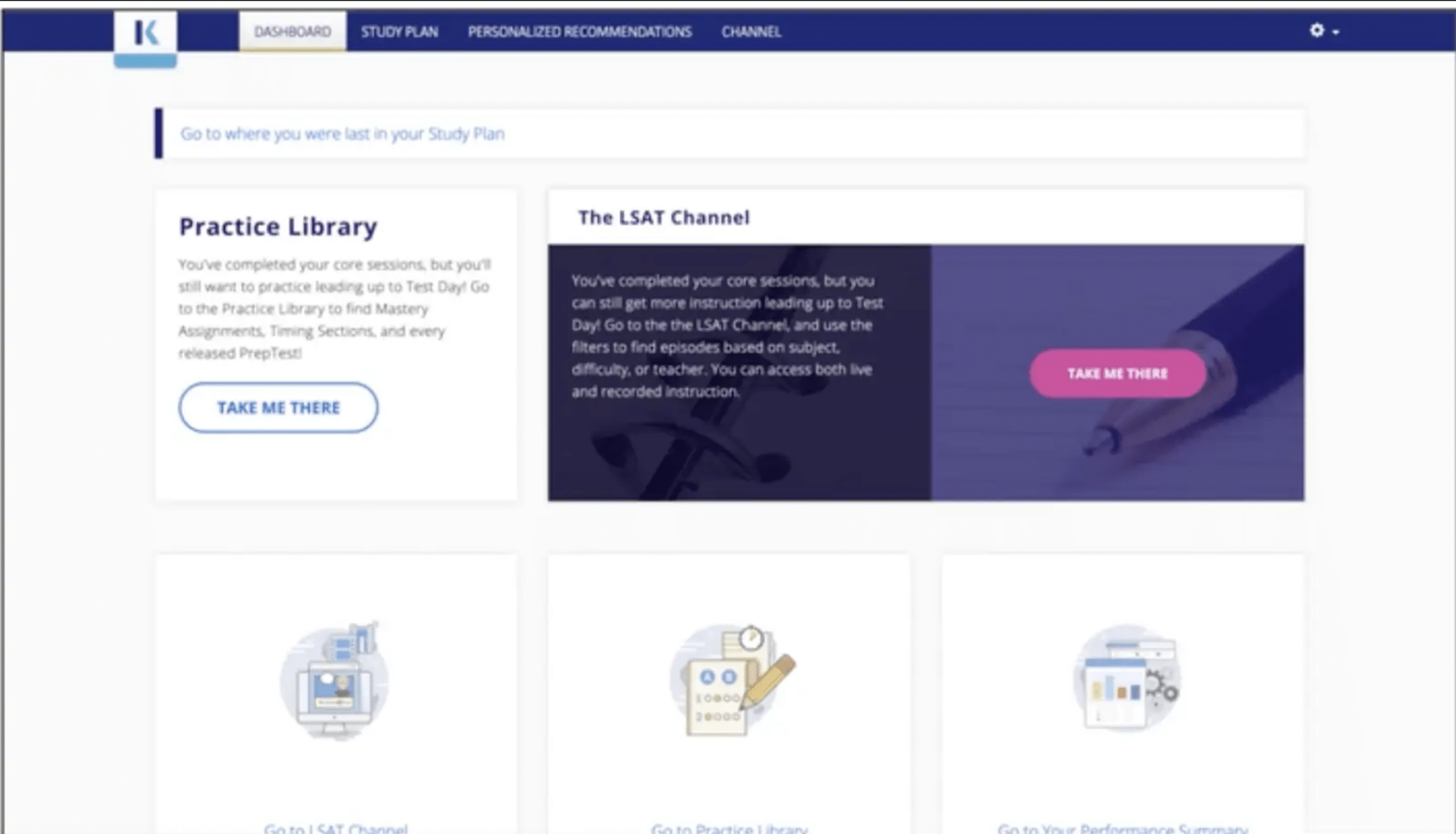
I liked this because it gives students another way to review topics that do not click the first time. Instead of only replaying the same assigned lesson, they can use the channel to get more instruction on problem areas. The only issue is that the LSAT Channel could become extra noise if a student already has trouble staying focused. They would need to use it for weak areas, not just watch more lessons to feel productive.
Kaplan’s Study Calendar and Instructor Help
Kaplan’s Personalized Study Calendar is one of the tools that keeps the course from feeling scattered. The calendar gives students a clearer plan for when to study, practice, and review.
The instructor access also makes Kaplan easier to trust. If a student gets stuck, they are not limited to reading an explanation and moving on. They can ask questions and get help from the instructor team.
I also noticed Kaplan’s interactive hints with instant feedback. That was useful because it gives help while working through a question, not only after getting it wrong. The limit is that Kaplan still feels like an older-school prep company. It is clear and steady, but not as sharp or personalized as the newer platforms.
Kaplan LSAT Course Packages
| Package | What’s Included | Best For |
| On Demand | Asynchronous lessons, instructor team access, interactive hints, instant feedback, and Personalized Study Calendar | Students who want flexible LSAT prep without live class times |
| Live Online | Flexible class schedules, livestreamed instruction, 99th-percentile-scoring LSAT instructors, and Personalized Study Calendar | Students who want a real class schedule from home |
| 170+ Course | 52 hours of live instruction, exclusive lessons, a proctored full-length practice exam, and 170+ guarantee terms | Students aiming for a high LSAT score with more pressure and structure |
| Tutoring Packages | Private one-on-one tutoring, flexible scheduling, Live Online course access, and a full study plan | Students who want personal help instead of only group instruction |
| Premium Tutoring | Premium tutor support, Live Online resources, and 170+ guarantee terms | Students who want Kaplan’s most hands-on option |
Kaplan LSAT Course Ratings
| Aspect | Rating |
| Lessons | 9.2 / 10 |
| Practice Questions | 9.3 / 10 |
| Explanations | 9.0 / 10 |
| Study Plan | 9.1 / 10 |
| Live Support | 9.4 / 10 |
| Ease of Use | 9.1 / 10 |
Pros
✅ Easy to understand without digging through the platform
✅ Uses nearly 6,000 released LSAT questions from LSAC
✅ LSAT Channel gives students more ways to review weak topics
✅ Instructor access helps when written explanations are not enough
Cons
❌ Not as modern as Blueprint or 7Sage
❌ Practice review is not the strongest for deep analytics
Bottom Line
Kaplan is the best LSAT prep course for students who want a classic prep-course setup with official questions, extra lessons, a study calendar, and instructor help. I ranked it second because it was easy to follow and gave more support than most basic self-paced courses.
3. Magoosh LSAT Prep: Best Budget-Friendly Course
Magoosh is a simple, self-paced LSAT course with official practice questions, video lessons, mobile apps, and study schedules. When I reviewed it, the course was easy to move through because the main tools were not buried in a huge platform.
I could quickly understand where to watch lessons, start practice, review explanations, and use the study schedule. That made Magoosh feel like a good fit for students who want LSAT prep they can manage on their own.
Magoosh’s Self-Paced Study Flow
I started by checking how the self-paced course was laid out. Magoosh kept the study flow simple: lessons, practice questions, explanations, and schedules.
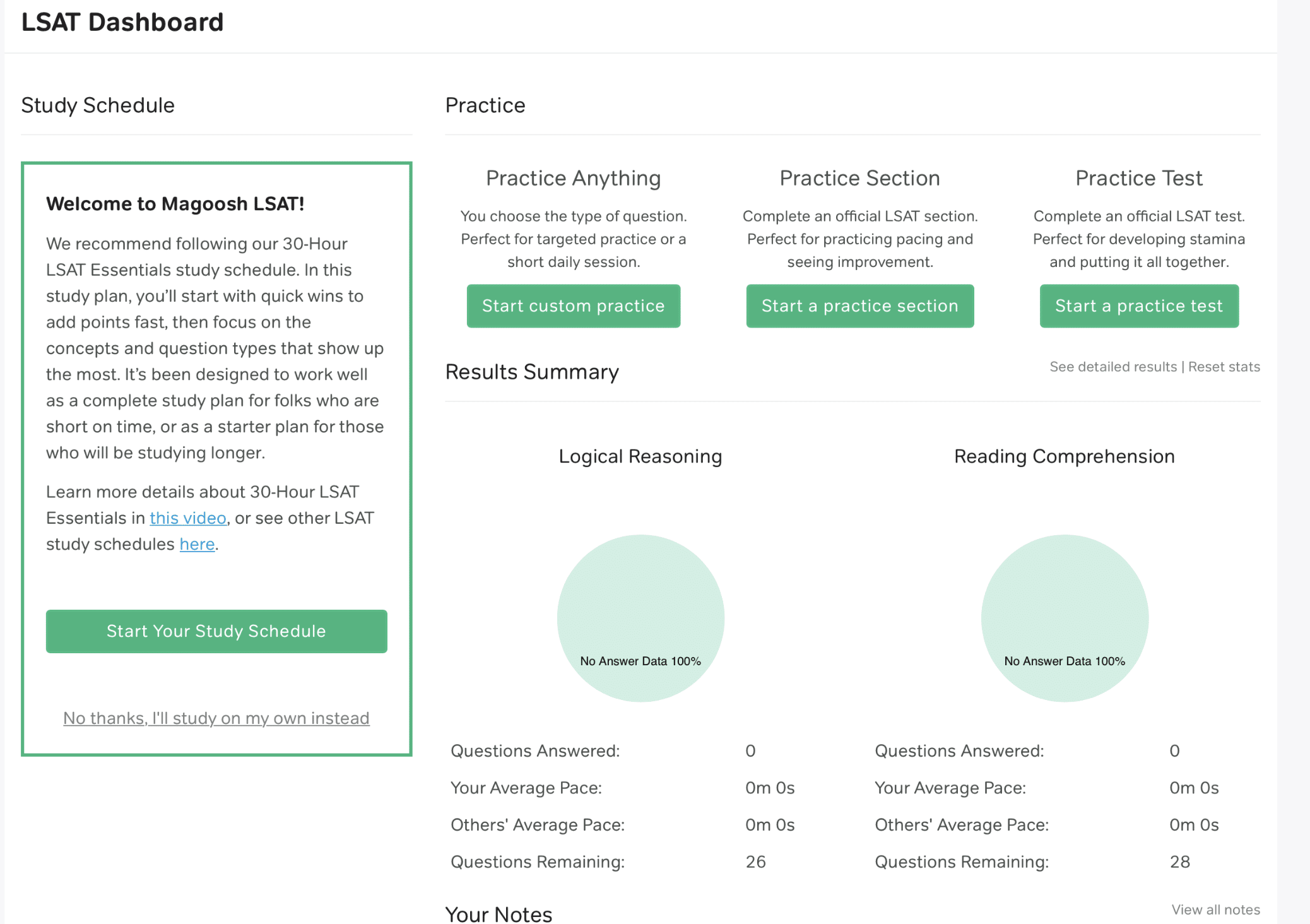
That made the course easier to use than I expected. I did not have to spend much time figuring out where to go next, which is helpful for students who want prep that feels direct instead of overbuilt.
This section was not flashy, but it was clean. For self-paced LSAT prep, that can be a real advantage.
Magoosh’s Video Explanations
I spent the most time checking Magoosh’s explanations because that is where a self-paced course has to carry a lot of weight. Magoosh includes more than 1,000 question explanations, explanations for every section of 10 full practice tests, and 700+ expert video explanations.
The video explanations made the review feel less flat than only reading the answer text. That matters when a student misses a Logical Reasoning question and needs to understand the thought process, not just the correct letter.
Magoosh also includes 80+ strategy lessons, so the course still has teaching built in before students jump into practice.
Magoosh’s Mobile Tools and Study Schedules
I also checked Magoosh’s mobile tools because this is one of the course’s better everyday-use features. Magoosh has desktop access, iOS and Android apps, notes, bookmarks, transcripts, timed practice tests, score conversions, and customizable study schedules.
The study schedules were useful because they gave the course more direction. Students can choose one- to six-month timelines, which makes the course easier to fit around a real schedule.
Magoosh still depends on self-discipline. It gives students the tools and the plan, but it does not create the same pressure as a live class.
Magoosh LSAT Course Packages
| Package | What’s Included | Best For |
| Premium | Self-paced prep, 12 months of access, 6,000+ official LSAT questions, 80+ strategy lessons, 1,000+ question explanations, timed tests, study schedules, tutor email support, score conversions, and +5 score guarantee | Students who want simple self-paced LSAT prep |
| Guided Study: Premium + On-Demand Classes | Everything in Premium, plus 12 hours of supplemental instruction, classes led by a 99th-percentile LSAT instructor, customized homework, targeted assignments, and video/text explanations | Students who want Magoosh with extra lesson support |
Magoosh LSAT Course Ratings
| Aspect | Rating |
| Lessons | 8.8 / 10 |
| Practice Questions | 9.2 / 10 |
| Explanations | 9.3 / 10 |
| Study Plan | 8.8 / 10 |
| Live Support | 8.4 / 10 |
| Ease of Use | 9.3 / 10 |
Pros
✅ Simple layout was easy to follow
✅ Video explanations made lessons easier to understand
✅ Mobile apps help with flexible study
✅ Study schedules gave the course more direction
Cons
❌ Not as hands-on as live LSAT courses
❌ Students who need outside pressure may want more support
Best Fit for Magoosh
Magoosh is best for students who want simple, self-paced LSAT prep with official questions, video explanations, mobile access, and study schedules. It is not overly complicated, which is the main reason it works well for independent study.
4. Princeton Review LSAT Prep: Best for Live Instruction
Princeton Review works best as a live LSAT course. The self-paced materials are there, but the live programs are the main reason I’d consider it. The course is built around class hours, PrepTests, drills, make-up options, and a dashboard that holds the materials together.
Princeton Review’s Live Course Options
I compared the live plans by class hours and flexibility. Fundamentals gives 30 live hours, the 170+ Course gives 65, and 170+ Immersion jumps to 130 live hours plus 56 workshop hours.
The 170+ Course made the most sense to me because it has more structure without going full overload. Flexible Attendance, live make-up classes, and repeat lessons are practical features. The Immersion plan is serious, but it could be too much for students who already struggle to keep up.
Princeton Review’s PrepTests and Drills
I opened the practice side to see how the PrepTests and drills were set up. Princeton Review includes 90+ official LSAT PrepTests through LawHub Advantage, online drills, answer explanations, and previously released questions.
The practice tools were useful, but they felt more like assigned homework than a fast drill system. That is not terrible for a live course, because the practice fits the class format. It just does not feel as quick or lightweight as a course built mainly for drilling.
Princeton Review’s Dashboard and Materials
I used the dashboard to move between lessons, drills, tests, recorded content, the LSAT Course Manual eBook, progress tracking, and performance insights. The dashboard helped because Princeton Review has a lot of moving parts.
The materials were not hard to find, but the course still felt bulky. Students who want a clean self-study setup may not need this much. Students who want live classes and a full prep system will get more out of it.
Princeton Review LSAT Course Packages
| Package | What’s Included | Best For |
| Self-Paced | Recorded lessons, online content, 90+ practice tests, LSAT Course Manual eBook, LawHub Advantage, online access, and guarantees | Students who want Princeton Review without live classes |
| Fundamentals Course | 30 hours of live instruction, expert instructor, recorded lessons, 90+ practice tests, drills, explanations, manual, and online access | Students who want a standard live LSAT class |
| 170+ Course | 65 hours of live instruction, Flexible Attendance, make-up classes, repeat lessons, on-demand lessons, drills, PrepTests, and 170+ guarantee terms | Students who want a serious live course |
| 170+ Immersion | 130 live hours, 56 workshop hours, recorded content, 90+ practice tests, drills, manual, performance insights, and 170+ guarantee terms | Students who want the most intensive option |
Princeton Review LSAT Course Ratings
| Aspect | Rating |
| Lessons | 9.1 / 10 |
| Practice Questions | 9.4 / 10 |
| Explanations | 8.9 / 10 |
| Study Plan | 9.0 / 10 |
| Live Support | 9.6 / 10 |
| Ease of Use | 8.7 / 10 |
Pros
✅ 170+ Course has useful make-up and repeat lesson options
✅ 90+ official PrepTests give students plenty to practice with
✅ Dashboard keeps the larger course from feeling totally scattered
✅ Best fit when paired with live instruction
Cons
❌ Immersion plan may be too much for most students
❌ Drills felt more like homework than quick, targeted practice
Will Princeton Review Work?
Princeton Review is best for students who want live LSAT classes, a set schedule, and lots of official PrepTest practice. I would not pick it for simple self-paced prep, but the live course setup is strong.
5. 7Sage LSAT Prep: Best for Smart Drills and Straightforward Self-Study
7Sage is a simple LSAT prep course with strong drilling tools, explanations, analytics, and study support. When I used it, the platform did not feel flashy or modern. It was plain, and honestly a little boring, but the tools were easy to understand.
That is not always a bad thing. 7Sage works better for students who care more about drilling official LSAT questions than using a polished dashboard. The course is not exciting, but it gives students a clear way to study, practice, and review.
7Sage’s Smart Drills
Smart Drills were the most useful part of 7Sage for me. I used them to see how targeted the practice felt compared with just doing full problem sets.
The tool made it easier to focus on specific LSAT question types instead of burning through random practice. That is where 7Sage is strongest. It gives students a plain but practical way to drill weak areas.
The design itself is not very engaging. It feels more functional than polished. But for students who just want to practice and review, the drilling setup does the job.
7Sage’s Explanations and Analytics
I used 7Sage’s explanations after practice to see how helpful the review process was. The course has explanations for every official LSAT question, with both video and text explanations.
The explanations were useful, but the overall experience was not exciting. It felt more like a basic study database than a modern prep platform. Still, having both video and text explanations helps when one format is not enough.
The analytics were also pretty straightforward. I could see how they would help students track weak areas, but they did not make the course feel advanced or especially fresh. They were useful, just not impressive.
7Sage’s Live and Coaching Tools
The Live plan adds daily live sessions, weekly proctored tests, office hours, class recordings, Ask a Tutor, and classes for each question type. Those tools make 7Sage feel less isolated, but the main course still has a very self-study feel.
The Coach plan adds a dedicated 99th-percentile coach, two 30-minute coaching sessions per month, an intro session, personalized study sessions, weekly accountability emails, same-day scheduling, rollover sessions, and priority tutor responses.
I would only move up to the coaching plan if a student really needs accountability. The base course is simple enough on its own, and not everyone needs extra coaching layered on top.
7Sage LSAT Course Packages
| Package | What’s Included | Best For |
| Core | Self-guided LSAT prep, AI Coach, Adaptive Study Scheduler, video course, Smart Drills, every official LSAT, explanations, and analytics | Students who want simple self-study with drilling tools |
| Live | Everything in Core, plus higher AI Coach limits, daily live sessions, weekly proctored tests, office hours, recordings, Ask a Tutor, and classes for every question type | Students who want basic self-study with live help added |
| Coach | Everything in Live, plus highest AI Coach limits, dedicated 99th-percentile coach, coaching sessions, intro session, personalized study sessions, accountability emails, same-day scheduling, rollover sessions, and priority tutor responses | Students who want extra accountability and personal support |
7Sage LSAT Course Ratings
| Aspect | Rating |
| Lessons | 8.6 / 10 |
| Practice Questions | 9.5 / 10 |
| Explanations | 9.3 / 10 |
| Study Plan | 8.8 / 10 |
| Live Support | 9.0 / 10 |
| Ease of Use | 8.2 / 10 |
Pros
✅ Smart Drills are useful for targeted practice
✅ Every official LSAT question has an explanation
✅ Simple layout is easy to understand
✅ Live and Coach plans add support if needed
Cons
❌ Platform feels plain and outdated
❌ Coaching may be unnecessary for independent students
Where 7Sage Works Best
7Sage works best for students who want simple LSAT drilling, official explanations, and a no-frills study setup. It is not the most polished course I reviewed, but it can work well for students who care more about practice than presentation.
How I Tested and Ranked These LSAT Prep Courses
I tested each LSAT prep course by using the same parts students care about most: lessons, practice questions, explanations, study plans, live support, and ease of use.
| Criterion | Weight | What I Tested |
|---|---|---|
| Lessons | 20% | Video lessons, module layout, teaching clarity, pacing, and how easy the course was to follow |
| Practice Questions | 20% | LSAT question banks, PrepTests, drills, timed practice, and full-length exam tools |
| Explanations | 20% | Written explanations, video explanations, missed-question review, and how clearly the course explained wrong answers |
| Study Plan | 15% | Study calendars, weekly schedules, adaptive plans, and how easy it was to know what to do next |
| Live Support | 15% | Live classes, office hours, tutoring, coaching, instructor help, and student support |
| Ease of Use | 10% | Dashboard layout, mobile access, navigation, and whether the platform felt simple or annoying to use |
Find Your LSAT Course
- I want the best all-around course: Blueprint
Good for students who want lessons, a study plan, official questions, full exams, and analytics in one cleaner flow. - I want a traditional prep course: Kaplan
Best for students who want a class-style setup with official questions, instructor access, and live options. - I want simple self-paced prep: Magoosh
Good for students who want video explanations, mobile access, study schedules, and a course that is easy to use alone. - I want live LSAT classes: Princeton Review
Best for students who want scheduled instruction, make-up options, and a heavier live-course setup. - I want plain but useful drilling: 7Sage
Good for students who want Smart Drills, official explanations, and a simple no-frills platform. - I want the most practice volume: LSATMax
Best for students who want lots of official PrepTests, a big question bank, videos, and mobile study tools.
How to Choose the Right LSAT Prep Course
- Pick live prep if you need outside pressure.
- Pick self-paced prep if your schedule changes a lot.
- Pick a drill-heavy course if practice is your main focus.
- Check explanations before anything else.
- Make sure the dashboard does not annoy you.
- Read guarantee rules before trusting the guarantee.
- Do not choose the biggest course if you only need simple prep.
My Final Verdict
Blueprint is my top LSAT prep pick because it has the strongest mix of lesson flow, study planning, official practice, and review tools. Kaplan is better for a traditional class-style setup. Magoosh is better for simple self-paced prep. Princeton Review is better for live instruction. 7Sage works for no-frills drilling, and LSATMax is best for practice volume.
FAQs
Are LSAT prep courses worth it?
LSAT prep courses can be worth it if they help you study more consistently, review missed questions, and practice with real exam-style timing. The best courses give you more than lessons. They help you understand why you missed a question and what to fix next.
How long should I study for the LSAT?
Most students should plan for at least two to four months of steady LSAT prep. Students starting far from their goal score may need longer, especially if they need more time to build timing, accuracy, and test endurance.
What should I look for in an LSAT prep course?
Look for clear lessons, strong explanations, official LSAT practice questions, full-length practice tests, study planning tools, and review features that help you spot weak areas. A course does not need to be huge to be useful.
Is self-paced LSAT prep enough?
Self-paced LSAT prep can be enough if you are consistent and honest about reviewing mistakes. It works best for students who can follow a schedule without outside pressure. If you keep falling behind, live classes or tutoring may help more.
Do I need live LSAT classes?
You do not need live classes to do well on the LSAT. Live classes are mainly helpful if you want a set schedule, instructor explanations, and more accountability. Independent students may do fine with a strong self-paced course.
How many LSAT practice tests should I take?
Quality matters more than taking as many tests as possible. Full-length tests help with timing and endurance, but review is where most improvement happens. Students should leave enough time after each test to study missed questions carefully.
Are LSAT score guarantees real?
LSAT score guarantees can be real, but they usually come with rules. Students may need to complete lessons, take required practice tests, meet attendance rules, or show a baseline score. Always read the terms before counting on a guarantee.

Bryce Welker is an unstoppable force in the worlds of business and education. He’s a dynamic speaker, expert blogger, and a regular contributor to top-tier publications like Forbes, Inc.com, Business.com, and AccountingToday.com. With a proven track record of founding over 20 innovative test prep websites, Bryce has helped countless students and professionals pass their certification exams and achieve their dreams. Whether you’re seeking career advancement or educational success, Bryce Welker is the ultimate guide to help you get there.
